 Skip to content

If you have ever read that laser hair removal only works on certain skin tones, that worry is understandable, and it is also outdated. At Luna Med Spa in Brookfield, WI, a provider determines candidacy by reviewing your skin, hair, and history, not an online chart. Here is what actually matters.
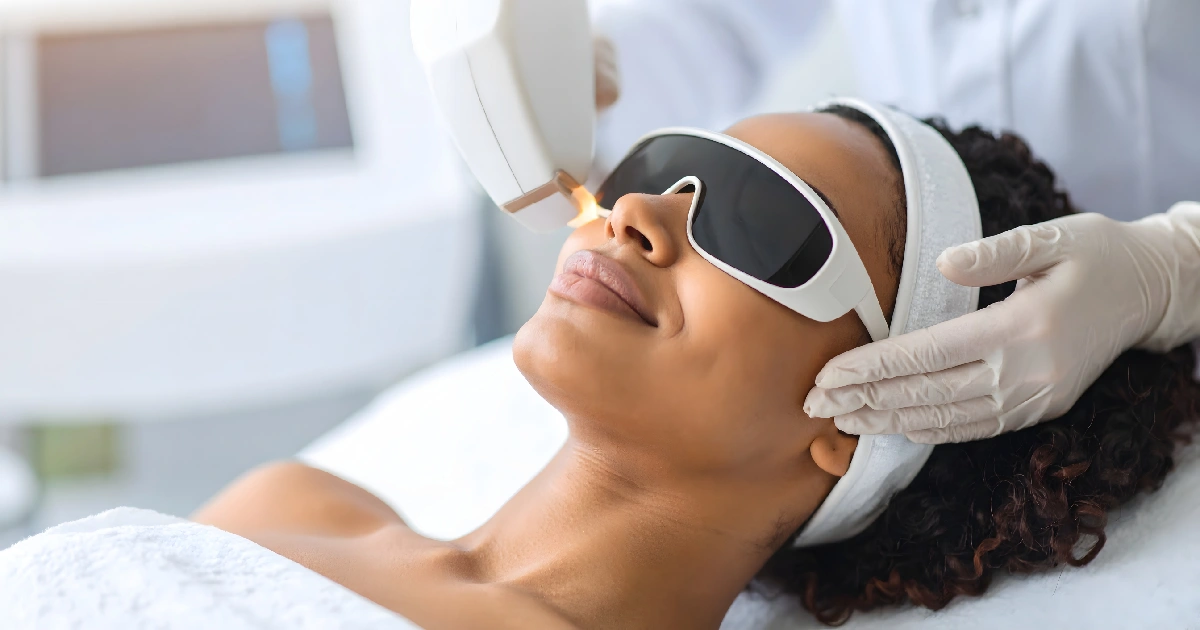
Yes, providers can treat deeper skin tones safely when they choose technology suited to your skin. Longer-wavelength lasers reach the hair follicle while passing through more surface pigment, lowering the risk of burns and pigment changes. During a consultation, your provider confirms the right device and settings for your skin type and recent sun exposure.
Lasers find hair by looking for pigment. Melanin in the hair shaft absorbs the light, converts it to heat, and that heat travels down to the follicle to slow future growth. It is a precise process, and it depends on the laser’s ability to distinguish hair pigment from skin pigment.
That is where skin tone comes into play. Your skin contains melanin too. The greater the contrast between dark hair and lighter surrounding skin, the easier the device can make that distinction. When skin and hair have similar pigment levels, the laser has to work harder to stay focused on the follicle, which is why the same machine doesn’t behave the same way on everyone.
Hair color matters just as much. Light blonde, gray, white, and red hair contains very little pigment, so the laser has little to target, no matter how fair or deep your skin is.
The Fitzpatrick scale is the clinical shorthand providers use to describe how your skin responds to UV light. It runs from Type I, very fair skin that burns easily and rarely tans, through Type VI, deeply pigmented skin that rarely burns. Most people land somewhere in the middle and are surprised to learn where.
Your provider is not using the scale to label you. They are reading three things: how much baseline pigment your skin carries, how your skin reacts to sun and heat, and how much sun you have had recently. That last one changes often.
Guessing your own type is a fine starting point, but it is only a starting point. A Type III who spent August outdoors may temporarily behave more like a Type IV, and settings should reflect the skin the provider sees that day.
Deeper skin tones can absolutely be treated, and today that is routine rather than exceptional. The key is wavelength. Longer-wavelength lasers penetrate deeper than surface pigment and deliver energy to the follicle without overheating the surrounding skin, making them the safer choice for Fitzpatrick Types IV through VI.
The flip side is also worth saying plainly. Older broadband light and IPL-based systems are generally not appropriate for deeper tones because skin pigment absorbs that light too readily. Luna Med Spa offers both traditional laser hair reduction and Sciton® BBL laser hair removal treatment, and part of your consultation is determining which of those is appropriate for your skin, rather than assuming one fits everyone.
Fair and medium skin tones are usually the easiest to treat because the contrast between light skin and dark hair gives the laser a clear target. Sessions are often comfortable, and settings can be more efficient from the start.
At this end of the scale, the limiting factor is rarely your skin. It is your hair color. Fine, blonde, or gray hair on fair skin may respond only partially, and an honest provider will tell you that before you commit to a plan for body hair removal or facial hair removal.
Most side effects of unwanted hair removal by laser are mild and short-lived. Expect some redness and small bumps around the follicles, a sensation similar to mild sunburn, and sensitivity that usually settles within a few hours. The risks that shift with skin tone are pigment-related.
When settings are too aggressive for the skin being treated, pigment can temporarily lighten or darken in the treated area. Deeper tones are also more prone to post-inflammatory hyperpigmentation, the dark marks that linger after skin has been irritated. Burns and blistering are uncommon with trained providers using appropriate devices, which is why device selection isn’t a technical detail. It is the safety decision.
The strongest candidates have dark, coarse hair and skin that hasn’t been recently tanned, at any point on the Fitzpatrick scale. Results tend to be more limited with very light, gray, or fine hair, regardless of skin tone.
There are also good reasons to wait rather than to rule yourself out:
Melasma, a history of keloid scarring, and any active irritation or infection in the area are all worth mentioning up front. None of them automatically disqualify you, but they do change the plan.
A consultation is where fit is actually settled. Your provider assesses your skin type, hair color and texture, medical history, current medications, and recent sun exposure, then matches a device and settings to your results. They often do a small test spot first so you can see how your skin responds before they treat a larger area.
Bring questions. Which device will be used for my skin type, how many sessions are realistic for my hair, and what should I expect afterward are all fair and useful questions. Permanent hair reduction is the clinically accurate goal here, meaning a long-term, stable decrease in regrowth rather than the total elimination of every hair, and our provider at Luna Med Spa will frame it that way from the beginning.
Your skin tone deserves a plan built around it. If you are considering Laser Hair Removal in Brookfield, WI, the team at Luna Med Spa can assess your skin type, explain your options clearly, and tell you honestly what to expect. Book Your Laser Hair Removal Consultation Today and start with a conversation.